The confusing subway map

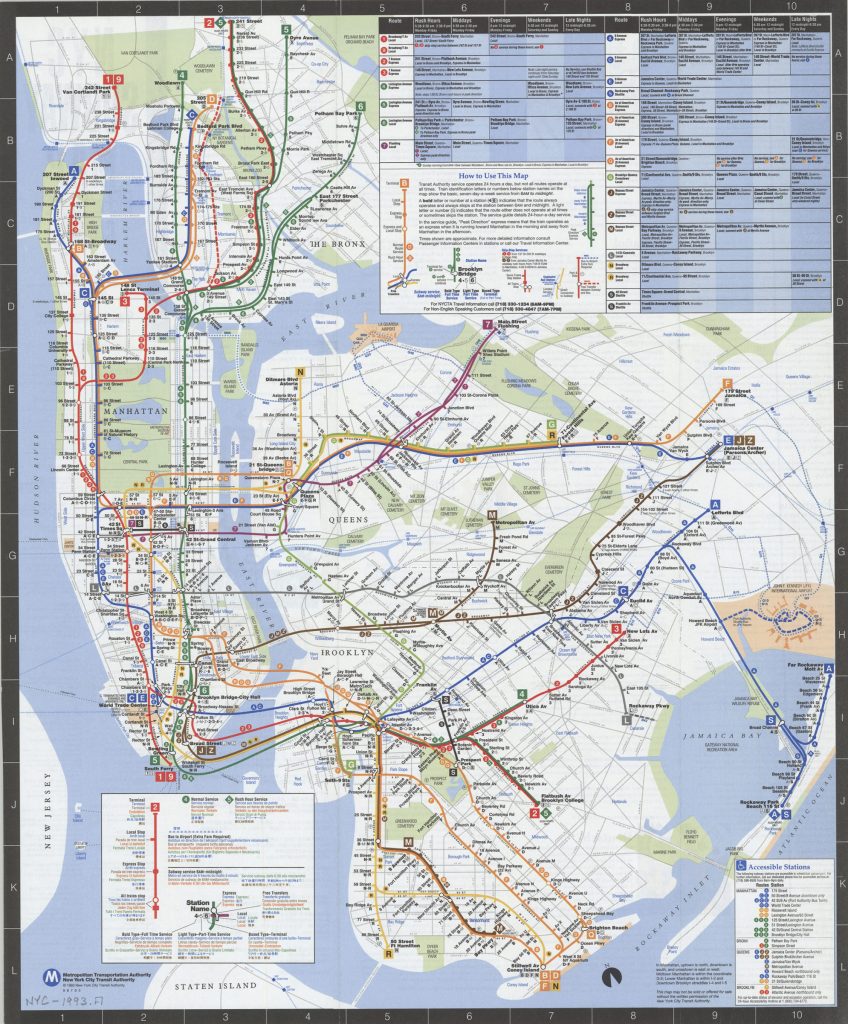
Subway map 1993
Credit: Brooklyn Historical Society

5 min read
The confusing subway map Captured Audience

The first time

i don’t remember the first time i used the subway in NYC. But i do remember as a teenager arriving at Penn Station and making my way up across the station looking for a map of the subway that is overlaid on the NYC grid. When i finally found it i remember being confused. The confusion i experienced was not because of the complexity, but rather, i experienced the confusion that comes from really having to pay attention. The sensation i’m talking about, is the same type you experience when you’re driving a car, and you find yourself lost that you turn off the radio in the car so you can really focus.

The sheer amount of detail of the subway map is marvelous. The first thing i notice is the way the red, blue, yellow, green and other colored train lines criss-cross. The beautiful colorful lines that mostly span north to south, and their sister lines from west to east that expand and spread out like a spider web into the boroughs out of Manhattan. After a few moments i remember that i’m on my way to the final destination, “oh right, where am i going again?”. But i’m in NYC, and i’m not the only one who wants to look at the map. There’s a small spread-out group of people behind me and i feel their heads moving from side to side trying to catch a glimpse of the map. Poor fellas, they’re still looking at the pretty lines, so i figure i’m ahead since I’m already looking for my destination. I’m at the “tracing my fingers from my current location to where i’m going” step. I turn and murmur to my friend, “This looks correct, right?”, my friend gestures with their hand and index-finger extended, pointing to their ear that they can’t hear me. Since I was caught up playing Sherlock Holmes subway-map-edition, I forgot how loud it is around me. There is a band playing in the background, the loud-speaker is making announcements, i hear indistinguishable chatter from hundreds of riders. I speak up again but a bit louder this time, and with a thumbs up gesture for confirmation, “I think we have to take this line to that stop, and transfer to that other line and stop over there”. 

Some history

The NYC subway opened in October of 1904. It currently has 472 subway stations making it the largest number of public transit subway stations of any system in the world. As of 2020 amid the global Covid-19 pandemic, 2 million commuters, tourist, and locals rode the subway everyday, a number that is less than half it’s total ridership pre-pandemic, which bolstered an average of approximately 5.5 million riders. That means that in a “normal” year the subway is responsible for around 1.7 billion rides. Times Sq-42nd st being the busiest station. Currently i live in long island, and I can travel 42 miles to Battery Park at the edge of lower Manhattan in a mere LIRR (el – eye – double-r pronunciation by majority vote on instagram ) train ride, a subway transfer, and a quick walk. After all these years, i’m still amazed of the accessibility to the boroughs, to Long Island, to New Jersey and Upstate NY through the subway and train system. I mean, you can even take the Amtrak to another another state from NYC. But having grown up in Guatemala for many years, i often think of accessibility via public transport – and especially trains – and who gets to ride them.

At Home

i’ve always loved trains, the sound they make, how the passing of a train usually commands respect and attention from anyone standing near the train lines. i love the linearity of their travel, the predictability of their schedule, the sound that the train wheels make on the tracks, chooka-chooka, chooka-chooka. When i was young around 8 years-old, my family moved to a city called Morales in Guatemala, and less than 50 yards in front of our home were the train tracks. By the time we moved to Guatemala the trains were no longer carrying passengers and were almost exclusively for cargo – at least in that area of the country. Like a sunrise, every day, the train would pass by in front of our house announcing itself with a loud choo-choo! a signal to the vendors that had set up a street market over the train lines to quickly move the foldable tables, the upright tents, the produce, the shoes, or whatever trade they were selling.

i’ve never been to the orchestra but when the train passed by the street market in Morales, my 8 year-old self knew it was experiencing a musical and organized delight. Or perhaps a stage theater production, the train being the central character and the stopped mopeds, cars, tuk-tuks (look them up, they’re amazing to ride), and the vendors, being the supporting cast with the moving platforms. The train would slow down enough that as kids we would run near the rear of the train where the conductor wouldn’t see us and we would jump on the ladder of the freight cars and hold on to our lives until we got off somewhere else in the town. I still remember, the clink-clink and vibrations of holding on to a freight train, the intense determination to conquer a moving train. The naiveté of thinking that in those moments, me and my friends where free and where going somewhere. For those few seconds and minutes, we were. 

i left Morales when I was 14, not in a train, but in a plane. All of my friends stayed there, a lot of them with no plane, or train ticket to get out. Guatemala suffers from the same deep social-economic injustices of generational poverty that many developing countries face. Many of the fruit, vegetable and meat vendors will probably never leave the beautiful but troubled city. The price for departure is too high, a train system that is not meant for them, but only for the foods and goods that keep them alive. They will probably never see a map of their beloved choo-choo train system. Much is different in NYC and even though it is one of the largest and wealthiest cities in the world, thousands of family’s still face many economic troubles. But the lucky ones of us, who have the $3 subway fair, can gaze at the criss-crossing lines that will continue to confuse thousands every day. i however, only get confused when looking at the map… sometimes. 

You must not fool yourself, and you are the easiest person to fool – On procrastinating.

November 16th, 2019

3 min read

In 1974 Richard Feynman gave the commencement address to the graduating class at Cal Tech. He said to them “The first principle is that you must not fool yourself, and you are the easiest person to fool. So you have to be very careful about that. “ His message was about having scientific integrity, but I think his message can help inform our daily lives.

“Each man and woman is a good education to himself”

I read a variation of this quote in a biography by Sarah Bakewell on the life of Montaigne. But the second part of this quote is one of my favorite points, it reads “provided he has the captivity to spy on himself from close up.”

We have two proposition: we can learn a lot by spying on ourselves and we must not fool ourselves knowing that we are easy to fool. Let’s look at a case study on procrastination, but this train of thought can be used in other areas that are important to you.

Case study on procrastination:

Part 1: Spying on yourself up close
You’ve decided to stop procrastinating and aspirate to become more diligent in your school work or professional career. However, you’re unsure why you procrastinate in the first place? Instead of going down an existential hole, let’s find the answer in a pragmatic way by invoking your inner James Bond and begin spying on yourself.

Take notes of when you want to procrastinate. Your education on this will probably happen while you are procrastinating -touché.

Does it happen in the morning, afternoon or evening?
Do I procrastinate after high stimulating activities that its hard to be patient and sit down, relax and do work? Do I procrastinate after going on my phone in the morning or after checking a specific app or website?
Does it happen when I don’t get a good night’s sleep or after hanging out with friends late night?
Does it happen after I hang out with family and their problems weigh on me?
Does it happen when my list of projects get so long that they stifle me? Maybe going to your favorite coffee shop distracts you from being introspective in what really matter in life.

It’s important that you take notes on the actions and mood that lead you to procrastinate. Literal notes too, this way after a few weeks you will have a clear and documented experience.

Part 2: Do not fool yourself
Here are some not so obvious ways that we fool ourselves

Going to the gym for too long in order to feel healthy but then being too tired to get work done
Focusing too much on planning and not executing
Prioritizing helping family and friends over ourselves – not setting boundaries
Believing that our “future selves” will figure it out – task postponement and wishful thinking
Not trusting that we are ready for the challenge – you will never feel ready

We all fool ourselves in different ways. For example, here is one way we can fool ourselves from accomplishing our goals that blew my mind when I first learned about it: talking and sharing our goals with others makes us less likely to do them. Why? Because we get a premature sense of completeness and this makes you less likely to do the damn thing! (crazy right?). See here for more info.

Implementing change

The next steps are not so simple and will require you to elevate your integrity. This takes time. Follow the 80-20 rule or Pareto principle, which states that 20% input creates 80% results. Identify your 20%. Be aware that the mind influences the body, but this is a bi-lateral effect, the body can influence the mind too. In other words, just get going and watch your minds perspective change and always remember – you must not fool yourself.

“ I Don’t Have Time” Myth

November 6th, 2019

2 min read

During my first year of graduate school I realized that the time management techniques that I had developed during my undergraduate degree needed to adapt. I had a lot more responsibility and felt that I was always working. I wanted to have control over my time. In order to adapt I began changing the language in which I approached life and I stopped saying “ I don’t have time”. I want to share with you how I think about time.

Think of your time in terms of 168 hour cycles instead of 24 hours cycles

Most of us think of our schedules in 24 hours cycles. However, fitting work, classes, meetings, exercise, cooking, sleeping, and spending time with friends and family in 24 hours is very challenging. Instead you should think of your schedule in 168 hours (one week) cycles. With this time frame, you can fit all of your activities and much more.

168 hours case study:

Daily sleep 7 hours x 7 days a week = 49 hours
Work from 9am to 5pm x 5 days a week = 40 hours
Total hours thus far = 89 hours
Hours left for the week = 79 hours !!

Even if you commute daily 1 hour back and forth that is = 10 hours
You still have 69 hours left.
Now you can fit in 5 exercise sessions that are 1 hour each = 5 hours
Read a book for 30 mins a day x 7 days a week = 3.5 hours
Total hours left = 60.5 hours.
With this much free time you can have a second full time job!

You control your time, time does not control you – prioritize

In order to control your time it is important to learn how to prioritize activities in your life. As we saw in the case study above, we all have plenty of time in our hands after our main responsibilities are completed. If you are a parent your schedule will look differently see here for tips.

Gone are the days were you said “ I don’t have time” instead you will say, “this is not a priority for me”.

With all that free time you can prioritize what is important to you.

For example:
Schedule time to hang out with friends
Sleep some more
Exercise
Play sports
Join committees
Volunteer
or Work on a new personal project

For more information see Laura Vanderkam’s book.

How to Choose Books and Audiobooks to Read and Listen:

Outline:
Backstory
How to choose a topic to read about
How to internalize what you’re reading

4 min read.

Backstory

Books have played a large role in improving my personal life. I grew up in a home where learning through experiences and oral tradition were emphasized. When my family wanted to teach me about discipline they made me sweep and mop our home often. There’s a story I like to tell my closest friends that in my home in Guatemala we had tile floors and I would sweep and mop the house. After I was done my dad would dust the bottom of his feet and slide his feet from room to room and if he found any dust I would have to do all over. Like I said, they wanted to teach me discipline, the importance of doing a job well done and consequences.

My journey into the vastness of literature didn’t start until after high school. Learning through reading is different then learning through experience. Reading introduces you to ideas big and small and they usually challenge your pre-conceived perspective of the world.

I read often. It is one of the ways I get to interact with the past, the ancient, the far-away countries and with cultures different from my own. Now that I’m more developed reader I have sharpened a practice that I think serves me when deciding which book I should read the next time I’m at the local books store (go support them!) or browsing through my kindle. Let me share some of my practices.

How To Choose A Topic To Read About

Think about your daily conversations with friends and family

This is a great place to start. How many times have you been in a room with friends or family that keep bringing a topic over and over and you have nothing meaningful to contribute? We’ve all been there. If you find that a topic is interesting and want to be part of the conversation, ask your family and friends if they have any book recommendations. That will be a good jumping off point.

Think about the national rhetorics

If you spend any time on social media like Instagram, Twitter, Reddit and Facebook (Hi moms and dads out there!) then you have a barometer on the hot topics in the U.S. and abroad.

Topics like Black Lives Matter, immigration and refugee crisis, feminism, the patriarchy, automation and the future of our jobs, constitutional rights regarding the second-amendment, U.S. educational system, how social media is making us depressed, etc., are all relevant and in the national consciousness. If you are tired of having the internet and other people making up the bulk of your opinion on a particular topic then perhaps you are interested in taking ownership of your thoughts on current affairs. This is a noble pursuit and it reminds of that quote that says, “There is no challenge more challenging than the challenge to improve yourself.”

How To Internalize What You’re Reading

In order to have original ideas that are free of idealistic thoughts and general opinion you will have to spend sometime invested in a particular topic. Once you have chosen a topic a good place to begin is by searching and buying the most recommended book in the field.

As you are reading and encounter new ideas practice articulating them by sharing them with friends. Try and find friends that usually have differing opinions than you. Saying out load what you’ve learned will help you identify the weakness in your knowledge and arguments. Practice!

While you are reading a book try to fit the story into contemporary context. This means reading your local and national news stories and comparing notes and testing the author’s ideas against that of the journalist.

Once you’ve read your first book, then read another from an opposing view or different perspective. Like everything in life, seeing it once will only familiarize you with the topic but in order to master the material you will have to re-visit the topic multiple times.

Finally, do not overlook novels. Novels are always written in the contextual perspective of its time. Authors usually find inspiration from the world around them and the journey and lessons of the protagonist are teachable moments meant to incite or shed light on old, current and new ideas.

First Year Ph.D. -Complete

My first year in graduate school just ended and there is so much to share but I want to focus on the challenges that I did not anticipate.

New Everything, Who Dis?

I arrived in Atlanta early August 2018. I was nervous and excited for this new chapter in my life. New city, new school, new program and soon new friends. Orientation is the same no matter what stage of school you’re in – pocket-folder full of forms and pamphlets, congratulatory remarks, information overload, and students looking for the nearest cup of coffee, and looking at your agenda for what time lunch is being served.

I joined the biomedical engineering department at Georgia Tech and Emory University and we have one month to interview potential Ph.D thesis advisers whose work and personality we find interesting. It’s kinda like a dance and everyone is trying to impress. At the end of the four weeks, both students and professors rank their top 5 choices and the matching process is complete. I can’t tell you how exciting and stressful this time period was.

I was told graduate school would be different. I thought I was prepared and for the most part I was ready for the challenges I anticipated. But here I want to share the challenges that I did not.

Asking for Help – Often

Usually the classes you take during your Ph.D. will be courses that add value to your research area. If you choose a research area that is different from your undergrad or work experience that means you will be learning a lot of new material. My first year had classes ranging from cell and molecular biology, to systems modeling to biotransport. I found myself having to ask my classmates for help more often than I’ve ever had in the past. What I ended learning this academic year was: that we all know a few subjects very in depth and have our weakness in others. Ask for help!

I Am Now The Professional (Sort of)

This experience might be particular to me but I think all students experienced this phenomenon at varying degrees. There is a disconnect between knowing something and being able to explain something clearly and simply. As a graduate student you are now expected to defend your work in a professional capacity. If you don’t know the science then who else does? (only a handful of people in the world actually). Everyone in research is working at the cutting edge of knowledge. There are high standards for doing research and having your knowledge and work examined through what sometimes feels like a microscope can be both challenging and humbling. This leads me to my next challenge.

Becoming a Scientist is a Humbling Experience

Have you ever tried playing sports or performing a challenging activity with people who are much better at it than you? With people who have clocked in years of hard work, experience, and are talented? That is what a Ph.D feels like as a first year student. Everyone knows more than you or it feels that way at least. You will be challenged every time you present your work. Professors, post-docs and senior graduate students are the gate-keepers of your area of research and knowledge. They are Gandalf if you will, and you shall not pass! It will be humbling to realize how much you don’t know and how immense the learning curve is. It has been a humbling experience for sure.

A serious Case of Imposter Syndrome

This is linked to the past challenge. Being surrounded by so many talented, smart and hard working individuals can sometimes make you feel small and insecure. You fail so many times at the beginning of your program and unavoidably you end up comparing yourself with everyone else. You attend seminar talks in your field and realize that you actually only know about 50% of what they’re talking about. The mountain top seems high from where you are sitting. One day I decided to open up and start asking other first years if they felt the same. I think without hesitation everyone responded with a variation of the same answer, “ I feel like I have no clue what I’m doing”. I was even surprised to hear classmates tell me that they felt I knew what I was doing – Ha!

If you’re working hard, are trusting the process, and are correcting course to improve, then all you can do is compare yourself to who you were yesterday. Everyone is struggling at one thing or another. Focus on your improvement.

Final thoughts

Ph.D. school is challenging but try your best to stay grounded. Find a group of friends that support one another. Seek activities in your new city to make it feel like you’re part of the culture and atmosphere. Prioritize character growth and focus on building your own principles and the work productivity will follow.